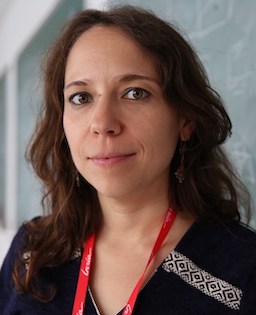
Vita Ayoub
Assimilation of satellite earth observation-derived flood maps for a better parameterization of large scale hydraulic models.
2022
University of Montpellier, 2022 (15/11/2018–14/11/2022).
Supervisor: C. Delenne; co-supervision: R. Hostache.
ORCID; theses.fr/2022UMONG094.
“Assimilation of satellite earth observation-derived flood maps for a better parameterization of large scale hydraulic models.”
Abstract With the objective of assessing flood hazard at a large scale, there is currently a growing interest for regional to global scale flood models. However, predicting flood hazard at high resolution and over large areas remains challenging due to (i) the recurrent lack of in situ hydrological data, (ii) the high computing demand of accurate hydrodynamic models when applied over large areas and (iii) the rather large model uncertainty due to physical simplifications, numerical approximations and uncertainty in input and geometrical data. In this context, the PhD focuses on one main research question: emph{How to optimally integrate large collections of satellite derived flood information for parameterizing and controlling large scale hydraulic models over data scarce areas?}The PhD leverages recent developements in hydrodynamic modelling and proposes an innovative hydraulic modelling framework based on the two-dimensionnal shallow water model with depth dependant porosity (SW2D-DDP). This model uses an unstructured mesh and incorporates porosity concepts in combination with the traditional 2D shallow water equations. In this model, the definition of porosity as a function of water depth allows for a more detailed representation of the floodplain and riverbed geometry, even when adopting comparatively large cell sizes. Thus, one of the main objectives of the thesis is the evaluation of the developed modelling approach for large-scale applications. Moreover, the lack of input data often required for hydraulic models, motivates the exploitation of satellite and topographic data, which are becoming increasingly globally available. Recent studies have enabled the automatic extraction of flooded areas via robust and effective algorithms. Nevertheless, automatic and efficient algorithms for estimating spatially distributed water levels are still lacking. Thus, a second objective is to develop an automatic water level estimation algorithm using satellite and topographic data only. In addition, the efficient integration of this remote sensing flood information into hydraulic models remains a crucial problem. As a matter of fact, a data assimilation algorithm (of inundation extent maps) based on a tempered particle filter is exploited to optimally combine observation and model data in order to: i) reduce the uncertainties related to these two sources of information and ii) optimally represent the bathymetry in this hydraulic model.